Showing posts with label 10 Questions. Show all posts

Monday, May 16, 2011

10 Questions with Rafer Roberts


In this second installment of "10 Questions with..." we feature Rafer Roberts. Above is a photo from last year's SPX of Rafer in the center with the Carnival Anthology carnies. Rafer has a new trade paperback out now called Plastic Farm: Sowing Seeds on Fertile Soil, which you can pre-order on Amazon or ask comic retailers to order it from Diamond using order code APR110754. Read on to learn more about Rafer and Plastic Farm.

1. How would you describe Plastic Farm to someone who has never read it before?

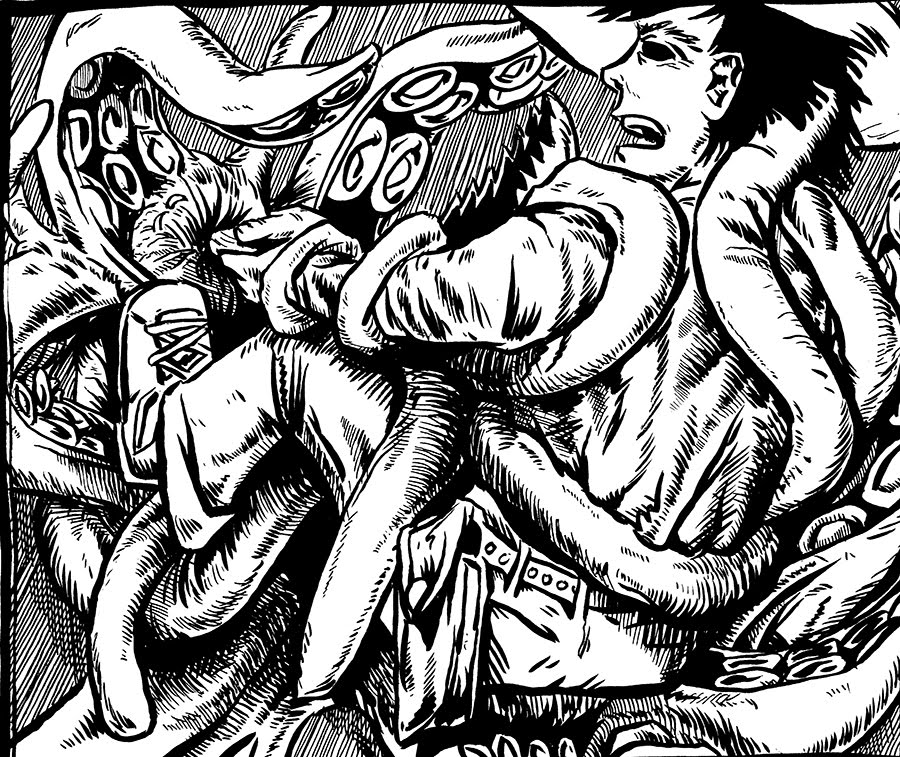
PLASTIC FARM is the life story of Chester Carter, his slow descent into complete insanity, and how that madness is reshaping reality in many strange, terrifying and hilarious ways. It is written and mostly drawn by me, and walks the delicate line between a serious treatise regarding the nature of humanity and our relationship with the sublime with dick and fart jokes.

We just released a new collection of the first 12 issues and folks are encouraged to pick that up from their local comics pusher.

2. Which cartoonists do you consider to be huge influences?

I'm not sure how much of it comes through in my artwork or storytelling but Dave Sim, David Lapham, Jack Kirby, Mike Mignola, and Ted McKeever all come to mind.


3. What are you inspired by outside of the art and comics world?

I'm a fan of crappy speculative documentaries about bible stories and the approaching apocalypse and I've been known to speed read the occasional bullshit new-age philosophy book. I've listened to a ton of Alan Watts lectures (who I actually enjoy) and I enjoy staring at the sky. Little snippets of overheard conversations, images from half-remembered dreams, old college sketchbooks filled in while a much younger me was out of my mind, and mis-read newspaper headlines all fill my brain with story bits. These bits float around my mind like rocks in a cement tumbler until they coalesce into a story or until I've ground them down to powder.

4. When did you start creating comics and what has kept you going after so many issues?

I started making PLASTIC FARM in early 1999, but many of the characters were appropriated from the comics I had been making since middle school. I don't know why I keep going. It's not like I'm getting rich doing this. I suppose I just have a story I need to get out of my head. I also enjoy the act of drawing; the zen-like act of sitting alone in a room making a series of lines that eventually approximate the form of a person or a building or whatever is very satisfying and keeps me sane.


5. You are the editor of Washington, DC's comic newspaper, Magic Bullet. What have you learned from this experience?

I've learned that being the editor of any sort of anthology project is a difficult and time consuming job. I've enjoyed my time as editor of MAGIC BULLET and I am damn proud of the product we have put out, but I've also realized that in order to steer the paper other projects fall by the wayside. I'm thinking that the next issue, MAGIC BULLET #3, will be my last as editor. I need to refocus on PLASTIC FARM if I'm going to finish it before I die.

6. What books have you recently read or are currently reading?

I'm terrible at this. I pick up so many books at shows that look great and they just sit in a pile unread waiting for me to have time for them, That said, I always have time for The Walking Dead. I wish Young Liars could have gone on longer (though I really wish Lapham could find a way to go back to Stray Bullets). I also highly recommend a book called The Signifiers by Michael Neno. Folks should go hunt that out.

7. You have been to many comic conventions recently. Do you have any fun stories from the road?

Yes, but most of them involve other people and I'm not sure I should talk about this stuff on the internet. Most of my stories actually involve me getting too drunk and making an ass out of myself in front of creators that I admire and respect.

8. Do you have any tips for someone interested in getting started in the comics industry?

Give up now. Go into banking.

Or, I suppose, take professional art lessons. That's the one thing I wish I had done and the one thing that has hurt me the most.


9. What upcoming projects do you have up your sleeve?

Hoo boy. There's two different anthology projects coming up that I'm not sure I can even discuss yet. I've got a short story in the upcoming FUBAR 2 World War 2 zombie anthology. It's a fun story and I got Jake Warrenfeltz to do some beautiful greywashes over my artwork. Jake and I are also working on another sort story written by our friend Stephen Hines. I've got some more Nightmare the Rat newspaper strips to draw, and of course, there is more PLASTIC FARM.

10. Where can people locate your comics?

Folks can find me at http://www.plasticfarm.com and the latest PLASTIC FARM collection is available in finer comic stores and bookstores everywhere, as well as online.

Now that you've read my interview with Rafer Roberts, stop by his blog to read his interview with me. Ten Questions with Carolyn Belefski: http://plasticfarm.com/?p=1075

Wednesday, March 2, 2011

10 Questions with Jim Coon


So I'm trying a new feature on this blog called "10 Questions with..." and the first person to experiment on is my lab rat, Jim Coon. It was actually kinda his idea! So it's pretty basic: we both interviewed each other and will post each other's interviews on our blogs. I met Jim at my first SPX show when I was walking around as a volunteer and got to talking with him about how he does what he does. Two years later, I started exhibiting at SPX and have been sharing a table with him each year at SPX ever since. Above is a photo of us from a previous SPX that I stole from his site.

Last year, I asked Jim to be a part of the Carnival Anthology. In this interview I found out that we are both influenced by Chuck Jones. Read on to find out more!


1. What type of comic work or cartooning do you do and how do you describe it to people you meet?

If I had to sum up the type of cartooning I do now a days I'd have to refer to the late comedian George Carlin. He said his "job" is thinking up goofy shit and then coming around once and while to tell people about it. I think that description fits what I'm doing right now with Last Dollar Comics to a tea. I've stopped doing sequential panel by panel comics because I found that more people were buying my books where the story was told one panel to a page. Books like Giant Robot Attacks or Bitch Stole My Fish were much more popular than the books with 5 or six panels per page. I subscribe to the K.I.S.S. theory. Keep It Simple Stupid.

2. Which cartoonists do you consider to be great influences in your work?

The animator and cartoon director Chuck Jones is one of my biggest influences. I love to watch any cartoon that he was involved with and see the similarities in expression and mannerisms in the characters. I think Jones may have been reflecting himself in his stories. Sometime watch How the Grinch Stole Christmas and then watch the Bugs Bunny cartoon the Rabbit of Seville and you'll see what I'm talking about. I think I get a lot of my cynicism from Charles Shultz and Don Martin was also a big influence on what I do now. In the early days of my publishing career when everyone was trying to draw like John Byrne, so was I. I think I have since shed any of the Byrne influences and I'm working hard to develop my own style.

3. How did you get started making comics?

I started making comics when I was in second grade drawing on any kind of paper I could get my hands on. I created my own characters, all super heroes of course. My first comic however was influenced by a Japanese monster movie called Yog: Monster from Space. I made a comic called Monster Island. Once I got to a point in my life where I had money and was deeper into the printing industry the self publishing really took off. I spent every Last Dollar (shameless plug) on publishing my own books and at one time was distributed by Diamond when my Dead End series was called Club 13. It was a DISASTROUS experience. The printer I used could print the sample books, but then couldn't hold registration on long runs. I had to change cover stock on the retail copies just to meet the distribution deadline. Years later I found an issue of Club 13 in a 25¢ box. That's when I knew I had arrived! LOL! My next venture to distribute books was a collected edition of Dead End. It was the first 10 issues which chronicled a Halloween night where the lord of the dead, Samhain, raises the dead and the streets are filled with zombies. Diamond rejected it saying there was no interest in zombie comics. I'd say I was about 5 years early as it wasn't long before zombies took over mainstream comics.


4. You are a proponent of mini comics. In your opinion, how can small press publishers make mini comics more visible to a larger audience?

As I see it the biggest hurdle for mini comics in general is distribution. Maybe hurdle is too small a word. Perhaps mountain is a more appropriate metaphor with the biggest mountain being Diamond Distributors. In my opinion Diamond wants nothing to do with small press in general. You can point to publishers like Top Shelf or Ad House who regularly have listings in Diamond catalogs, but to me, those publishers are not small press. They produce some very high quality books that sell at a price point that Diamond will benefit from. Until mini comics can be produced and packaged in a way that Diamond can profit from the sale I don't see a viable distribution system in place. Tony Shenton does a great job trying to fill this void, but it is to big undertaking for one man. I'm working on something now that I may or may not present to Diamond. I don't want to say much right now but if it works it could open a whole new door for small press.

5. When you are stuck on a project, what do you do to get in a better mindset?

It's hard for me to get in a better mindset when I get frustrated with a project. Fortunately it doesn't happen too often. With my minis I normally have the entire book written and sketched out before I work on the finished pages. If I have an idea for a story I'll jot it down in a book or I'll sketch out a character and then that stuff goes in a bin until all the pieces of the story come to me. I have characters that are just waiting for their story to be told, I just don't know what that story is yet.


6. Which book do you consider to be your most successful and why?

I guess I've never really thought about the success of one individual book. I always look at my books as a growing line of comics. I don't think I've really achieved the level of success with any of my books that I'm striving for.

7. You are an established caricaturist in Upstate New York. What are some of your most requested faces?

When I draw caricatures I always draw the face with a little body under it. The most requested bodies are Soccer, Basketball, Horseback Riding, Dancing, Singing, Baseball and Football. I could draw those in my sleep.

8. Do you have any tips for someone interested in getting started in the comics industry?

DON'T DO IT!!!!!!! Seriously, unless you are a hopeless optimist willing to get you dreams trampled on and you self esteem pulverized don't do it! That being said, if you think "Well, Jim doesn't know what he's talking about. 20 years of publishing indy comics isn't THAT long." then go right ahead and dive head long into the hell that is self publishing!
If you think that you have the next original super hero that is going to sell millions of comics and get you a movie deal I'd like to slap you upside the head with a big whopping dose of that magical elixir called REALITY! Marvel comics and DC comics try out new super heroes every so often and most of those books sell in the low thousands and last only a few issues. So if the 2 biggest comic companies in the country can't establish a new character what makes you think you can? So, forget the super hero genre all together. Teenage Mutant Ninja Turtles where created during a time when the market was not over saturated with super hero comics and the Diamond Distributor catalog was only about a quarter of the size it is today. There, the fanboys have stopped reading. Now, for those who want to publish small press comics...STAY AWAY FROM SUPER HEROES!!!! The small press community in general buys small press comics because they don't like stories about super heroes. They like stories about teen angst and boogers. Zombie pre-schoolers and and boxing fish. I'm always amazed when I see a couple of "playas" at SPX with the high quality full sized super hero comic and wonder why no one is buying it. Don't put your all your eggs in one basket. I've found I've achieved better results in sales by having a variety of different characters instead of trying to push one idea. If you create a character, let's say. a bunny with one eye, Zombie Cyclops Rabbit (copyright 2011 Last Dollar Comics, I'm gonna use that later) and you do several issues you are limiting yourself to just those people who like zombie cyclops rabbits. That is a small percentage. Instead of doing 10 issues of Zombie Cyclops Rabbit, do 1, then move on to a different character - Angry Monkey Finger Puppet (copyright 2011 Last Dollar Comics, that one is already mine) and write a story about that. Eventually, you'll have several books that appeal to a broader spectrum of buyers. I've found that my Giant Robot character sells well so I've used the character in 3 books. Little Lost Yeti is popular so I'll be doing a second issue of that. At some point one character will break away from the pack to establish it self as your signature character. Finally, if you're going to do a comic - DO IT! Don't tell me you're working on it while you promote it with your 2 sided UV coated postcards and flashy website! Don't give me a "preview" copy of a book filled with pin ups and sketches. Complete your book and THEN promote it. Ideas are a dime a dozen and in small press product is key. Also, make your comic a self contained story. It's hard to maintain the pace of a serialized book when you are doing it on a part time basis. Don't leave people hanging with a "to be continued" because chances are there won't be a next issue. I'm guilty of this myself. It's not fair to a reader to give them only the first part of what you intend to be a six part story.


9. What are your upcoming comic projects?

I've been trying to finish a 16 page story for Rafer Robert's Plastic Farm for over a year now. I'm amazed he hasn't given up on me. I'm almost finished with a new mini that is a spoof of Sesame Street and the song "Who are the People in Your Neighborhood?". I'm also finishing a book about Nightmares that is a fun little rhyming story.

10. Where can people find your comics?
Buy my books at my etsy store www.jim8ball.etsy.com or just send me your address and I'll come to your house! LOL!

Now that you've read my interview with Jim Coon, stop by his blog to read his interview with me. Ten Questions with Carolyn Belefski: http://jim8ball.blogspot.com/2011/03/10-questions-with-carolyn-belefski.html